Friends of Elizabeth Street Garden today announces a lawsuit against New York City to stop the destruction of Elizabeth Street Garden, a treasured green space located between Prince and Spring streets in Little Italy. Assemblymembers Deborah Glick and Yuh-Line Niou, who represent the constituents where the Garden is located as well as the adjoining district, along with Little Italy and SoHo residents, will serve as co-plaintiffs. The suit claims the city’s effort to develop Elizabeth Street Garden into a seven-story mixed-use building is unlawful.
The suit seeks to stop the ULURP proceedings because the city acted illegally, issuing a “negative declaration” claiming that there are no significant environmental impacts, brushing aside possible ground contamination from hazardous materials.
The suit also asserts that the finding by the Department of Housing Preservation and Development that the beautiful Garden is “blighted” (in order to exempt the project from real property taxes and provide other owner benefits) is invalid.
Additionally, the suit notes that the property is subject to a declaration, that it may be used solely for educational purposes and that it is subject to obligations of city personnel to hold the property in trust for the Board of Education. The development also would violate the New York State Constitution’s prohibitions against municipalities making gift and loans.
The de Blasio administration and Council Member Chin have repeatedly ignored constituents and local community groups, who overwhelmingly support saving Elizabeth Street Garden. The area is starved for open space, and the 20,000-square-foot park is open to the public year-round, offering more than 200 free public events annually and attracting more than 100,000 visitors each year.
“It’s a real pleasure working with such a devoted group as Friends of Elizabeth Street Garden. They know that the Garden is a jewel. They know that its modest size makes it a very potent symbol. The city talks of preserving public open spaces, but it must act. The open public space within a half mile of the Garden, including the Garden, adds up to just ten percent of what the City proclaims is the rock bottom need for a residential area. That makes even a small jewel a big symbol,” said Friends’ counsel Michael Gruen.
“Green space in our downtown community that has long been considered and used as a garden is in effect a park enjoyed by the public. Elizabeth Street Garden is an oasis of open space, light, and air in a community in Lower Manhattan that lacks equitable park space. While the pursuit of building more affordable housing and senior housing in our communities is a noble goal, the city must work with local residents in a transparent process to find equitable solutions that will produce the most good in our neighborhoods. That includes ensuring that when a community finds alternative and more appropriate sites for affordable housing, the city does not simply disregard those efforts because it is easier to build on a site that happens to be a community garden. I am happy to be a co-plaintiff in this lawsuit and feel strongly, as I have advocated in the past, that if the community adopts an open space as a park, it should remain a park,” said Assemblymember Deborah Glick.
“Our community stepped up and created new open space when the city would not. We engaged our community to develop Elizabeth Street Garden into a jewel which meets the needs of our community. Our community severely lacks green space. Lower Manhattan is in need of affordable housing, but we cannot pit the need for housing against the need for green space, especially when good alternatives are available. Both are vital and both are in dire need of protection and expansion. The neighborhood has an open space ratio of a mere .07 acre per 1,000 residents, far below the city's target goal of 2.5 acres per 1,000 residents. The current plans for the Garden lower the open space ratio even further for non-permanent, affordable housing. Together, we must evaluate the city's decisions regarding Elizabeth Street Garden and work towards a community-based plan that provides proper attention to environmental impacts and addresses the need for affordable housing,” said Assemblymember Yuh-Line Niou.
“Elizabeth Street Garden is a vital part of the Little Italy and Soho communities, an indispensable asset to all who live, work and visit. Its beauty and peaceful, open expanse to the sky gives sanctuary in a city that can be unrelenting. To destroy it, when there is a better alternative site, is not only bad city planning but also unconscionable” remarked Emily Hellstrom of Friends of Elizabeth Street Garden. “The city has turned its back on our grassroots movement, but we will not back down in the face of this willful disregard.”
“The city has a win-win opportunity: save the beloved Garden -- the only green space in our neighborhood -- and build up to five times as much affordable housing at the nearby CB 2-supported alternative site, a city-owned gravel-filled lot at 388 Hudson St.,” said Jeannine Kiely, president of Friends of Elizabeth Street Garden. “In fact, the city announced a similar win-win swap in Chelsea, where it is creating a new park on West 20th Street and building housing on a larger city-owned site two miles north.”
About the Legal Case
For more information on the specifics of the legal case:
A. A negative declaration asserts that there is no likelihood of any significant adverse environmental impact. In this case, the environmental assessment that the negative declaration is part of reads there may be a possible adverse impact that has not yet been tested, namely possible ground contamination from hazardous materials. The law states there can’t be such a possible adverse finding in the negative declaration, thus voiding the negative declaration and making it impossible to proceed further with ULURP because a legitimate negative declaration (or full-scale environmental impact statement) is required for the ULURP process.
B. There are several other significant environmental issues: The EAS (environmental assessment statement) arbitrarily says that eliminating the Garden does not do any harm, even though it will reduce the extraordinarily minuscule amount of public open space this area has by about 2.5 percent. That’s in an area that has only 0.153 acres of public open space per 1,000 residents, despite the city considering 2.5 acres the necessary amount. The major stated reason is that our community has so little public open space in this area already and that losing some of it just doesn’t matter. The city’s guidelines on this issue say just the opposite.
C. DHP appears to claim “blight” solely for the purpose of being able to strew huge advantages in front of builders. The idea that an outstandingly beautiful, and well-maintained, and popular, outdoor sculpture garden is “blighted” is absurd. The way DHP gets there is to call the Garden “vacant” because it has only a couple of small utility sheds, and claim that “vacancy” and “blight” are synonymous. On that theory, you could call Central Park “blighted.” It makes no sense.
D. There are two categories of trust issue at work here. First, the property is subject to a charitable trust from the time it was owned by a public charity that had built a school on it and declared that the school would be maintained forever. When the property was transferred to the Board of Education, with the school intact, the Board accepted it subject to any encumbrances there may be, and the forever condition was such an encumbrance. Second, under the City Charter, the city holds title to all public educational property, but in trust for the benefit of the Board of Education (which is an independent body). Granting this property to a private investment consortium for $1 plus property tax exemption and other benefits may make the consortium happy, but it does nothing for the trust beneficiary – the Board of Education. A further wrinkle: The City Council, its members, and all other officers and employees of the city are personally responsible for enforcing the Board’s trust rights.
E. The state constitution also prohibits the city government from making gifts and loans to private parties. It may be that such transfers for a public purpose are exempt. But that can only go so far. If the price and other emoluments are much more generous than necessary to induce the buyer to provide the public benefit, the deal starts to look more like a gift. Here, the $1 price tag, the fact that only about 80 percent of the building is to be used for low-income housing, the consortium getting the advantage of a property tax exemption, and quite possibly more goodies, looks very suspicious.
About the Legal Team
Friends has retained Michael Gruen, an experienced land use attorney with a proven track record litigating against New York City and state governmental entities. Gruen is president of the City Club, a good governance organization that recently won two important land use cases — Pier 55 and Flushing Meadows.
In the Pier 55 litigation, after the City Club’s major victory in federal court, NYC Parks management agreed to protect the river, and Governor Cuomo committed to “work cooperatively to complete the full vision” for Hudson River Park. For Flushing Meadows, the City Club’s litigation successfully blocked the development of a proposed 1.4 million sq. ft. shopping mall on designated parkland near Citi Field.
About the Garden and Friends of Elizabeth Street Garden
Elizabeth Street Garden is a unique public green, open space with an open lawn; majestic trees; flowering garden beds; and beautiful sculptural and architectural elements located in the Little Italy neighborhood of Manhattan, between Prince and Spring streets. City-owned and privately leased, the Garden attracts more than 100,000 visitors each year, including local elementary school students; families and seniors; and those who work in the neighborhood, as well as residents from around the city and tourists from around the world.
The Garden is open to the public seven days a week, weather permitting, and volunteers provide free public and educational programming year-round. The Garden's design, size, and configuration make it ideally suited for movies, music, yoga, community festivals, arts performances, educational programs, gardening and quiet meditation that are not offered in any other nearby public community space.
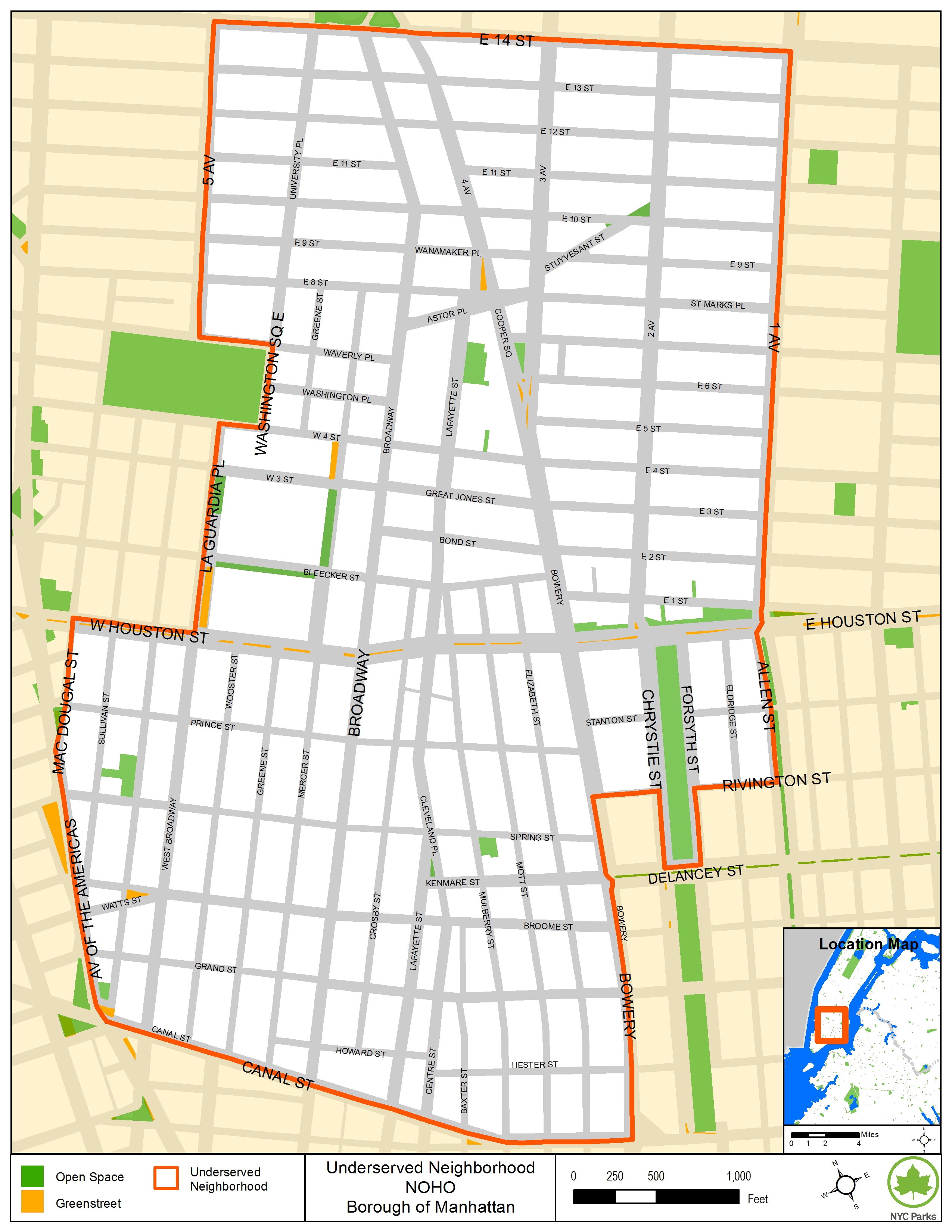
The Garden provides the only open green space in Little Italy and SoHo, a neighborhood with an open space ratio of 0.07 acre per 1,000 residents (3 square feet per person — about the size of a subway seat, and 100 percent paved), well below the city goal of 2.5 acres per 1,000 residents (109 square feet per person). The Garden is also part of the only downtown Manhattan neighborhood that the NYC Parks Department defines as underserved by open space, under City Environmental Quality Review.
Friends of Elizabeth Street Garden is a 501(c)(3) nonprofit organization with the mission to preserve the Garden as a unique public green, open space and NYC Park. (elizabethstreetgarden.org)
Friends of Elizabeth Street Garden (Friends) and Elizabeth Street Garden (ESG) continue to coordinate their legal efforts to achieve their shared goal of saving the Garden from development.