
Summary
- Virtu Financial is a technology-enabled market maker and execution services firm.
- Over the past few years, the company has made two material acquisitions, KCG Holdings and ITG, extracting material synergies.
- ITG, in particular, has broadened Virtu’s product offering in an effort to reduce earnings volatility and improve its organic growth prospects.
- Despite these efforts, the share price languishes below its 2015 IPO levels.
- I am neutral on this stock.
Business overview
(Source: Q2 2019 presentation)
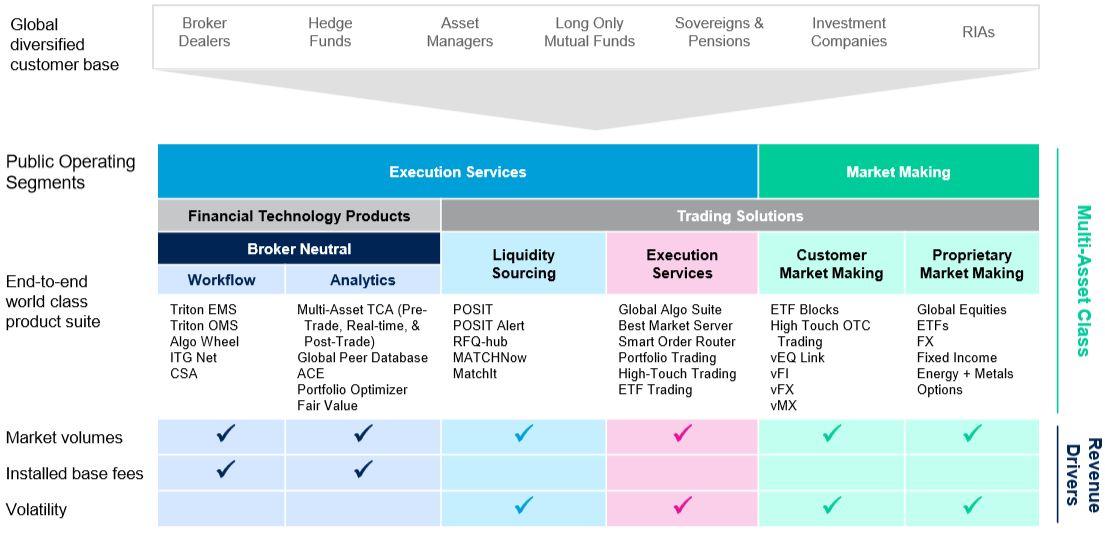
Virtu Financial (VIRT) traces its roots back to the New York Mercantile Exchange trading pits, where co-founder Vincent Viola worked as a market maker. Today, the company still derives the majority of its revenues from market making activities that delivers liquidity in over 25,000 securities on 235+ venues and in 36+ countries. It also offers trading solutions and analytics tools to clients interacting directly with broker / dealers, asset managers, hedge funds and other financial institutions. Virtu services over 25% of the “Rule 605” retail order flow in the US.
It has developed a multi-asset, multi-currency technology platform that is integrated directly with exchanges. This enables Virtu to scale its activities without incurring material additional costs as it adds additional securities and other financial instruments. In the past few years, Virtu has made two material acquisitions closing its purchase of KCG Holdings (KCG) in July 2017 and Investment Technology Group (ITG) in March 2019. These are covered in more detail below, as they are central to understanding Virtu’s transformation and another core capability, realizing material synergies from its M&A activities in line with its low-cost structure strategy.
KCG acquisition
(Source: Q3 2017 earnings presentation)
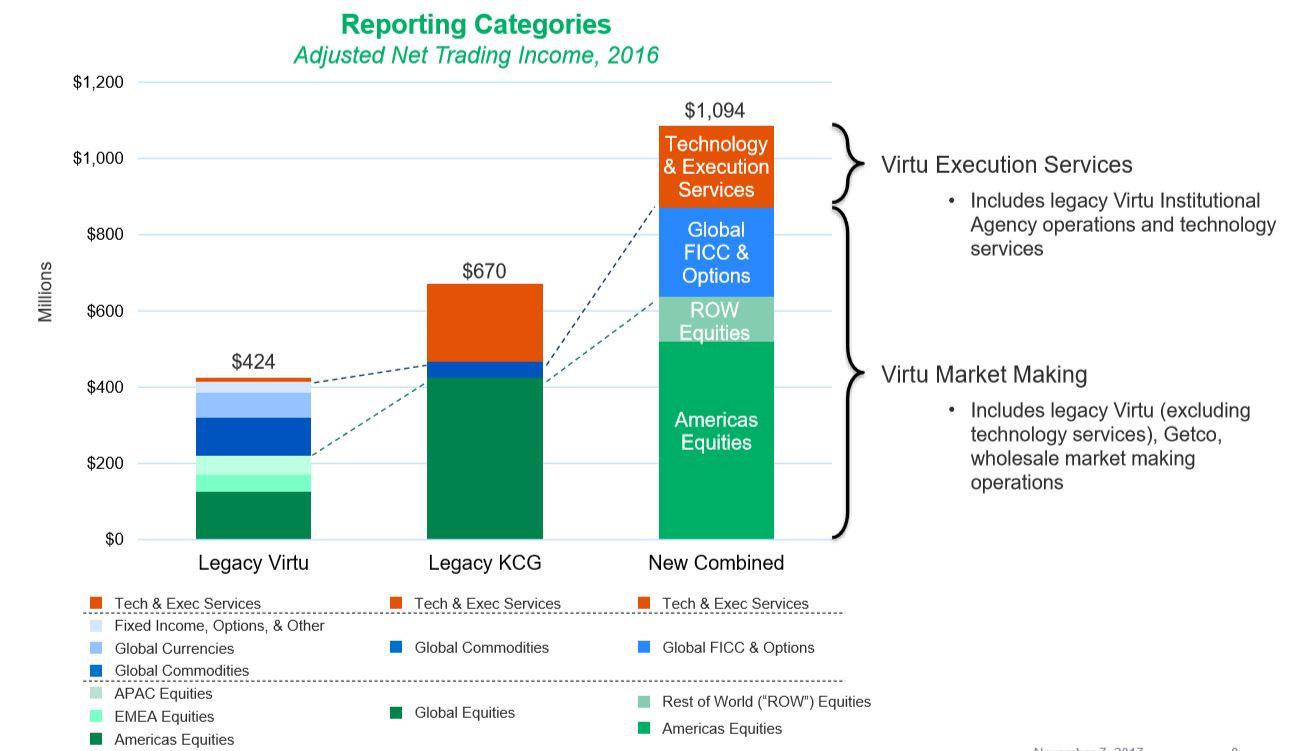
In April, 2017, Virtu announced it had entered into an agreement to acquire KCG Holdings for approximately USD1.4 billion. KCG Holdings was formed when Getco bought Knight Capital Group in December 2012 after Knight Capital Group suffered a USD440 million loss from a massive trading error in August 2012. As shown in the slide above, the KCG acquisition scaled Virtu’s operations considerably, particularly in wholesale market making and technology and execution services that offer clients a wide range of services, including algorithms and proprietary analytical tools.
Following the acquisition, Virtu started reporting two operating segments from Q3 2017: Market Making and Execution Services. Both companies use technology to increase efficiencies, and migrating the combined company onto a single platform was an integral part of the acquisition rationale. At the time of the announcement in April 2017, Virtu expected to realize approximately USD208 million of expense synergies and USD440 million in capital synergies. As discussed in the next paragraph, the company was able to significantly exceed these expectations.
(Source: Q4 2018 earnings presentation)
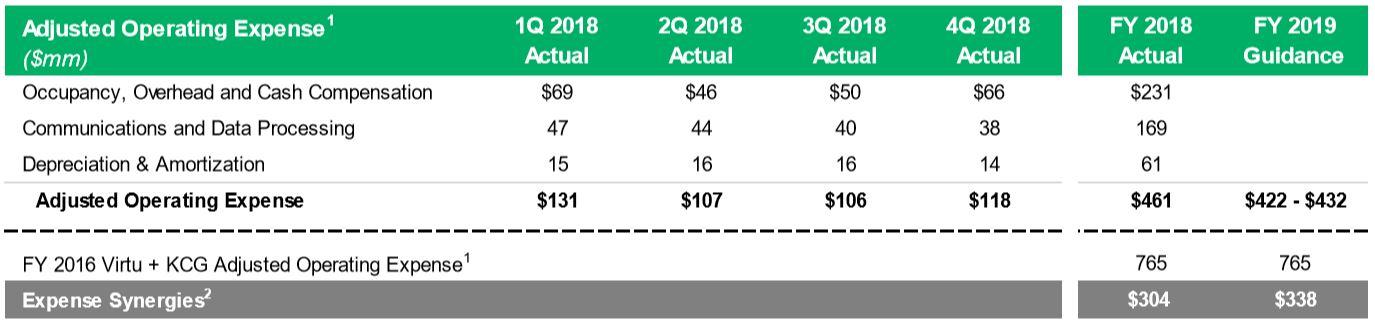
Per the table above, for FY2018 Virtu reported adjusted operating expenses of USD461 million. When compared with FY2016 pro forma Virtu + KCG adjusted operating expense of USD765 million, this implies USD304 million of realized expense synergies. For FY2019, Virtu planned to reduced adjusted opex further to a mid-point of USD427 million, increasing expense synergies to USD338 million (this excludes the ITG acquisition). In addition, debt repayments totalled USD750 million since the KCG acquisition closed in July 2017 (including BondPoint net sale proceeds of about USD400 million), reducing debt to USD907 million at the end of 2018.

