
Summary
- For its third-quarter earnings, Blackstone reported strong Distributable Earnings supported by growth in Fee-Related Earnings.
- Momentum from the C-Corp conversion and the fundraising supercycle propelled the stock up 77% YTD.
- Limited drivers slow upward momentum, as fundamentals need time to catch up.
Last week, Blackstone Inc. (NYSE: BX) reported third-quarter earnings with few highlights except to stress the importance of Fee Related Earnings("FRE") to the current and future shareholder payouts. Blackstone has been on a hot streak for the year, up 77% versus 21% for the S&P 500. The main catalysts for the upward momentum - the C-Corp conversion and the successful fundraising supercycle - have been spent with the LTM dividend yield of 3.63% (3.46% excl. special dividend) now comparable with defensive stocks.
Third-Quarter Earnings Recap
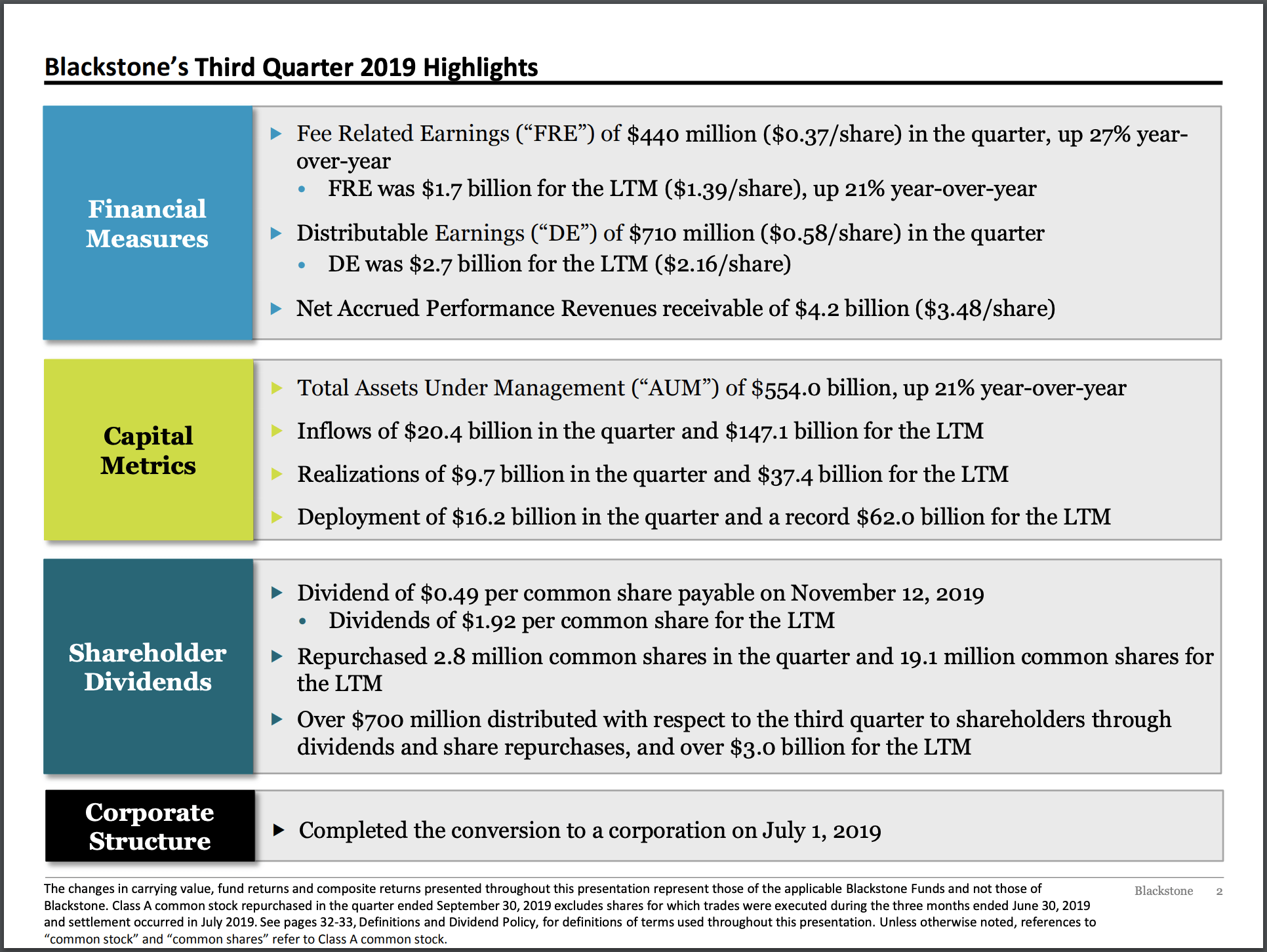
(Source: Blackstone website)
For the quarter, Blackstone reported Distributable Earnings("DE") of $710 million, which was down 7.7% and flat Y-o-Y and Q-o-Q, respectively. The company declared a dividend per common share of $0.49, only a penny higher than the previous quarter but 10% lower than the third quarter of last year (excl. special dividend). The largest alternative asset manager continues to grow AUM with a record $554 billion reported at the end of the quarter, with plans to raise funds for new business lines including life sciences and growth equity.
The Importance of Fee-Related Earnings
FRE is the management fee Blackstone charges LPs to manage their funds, and as long as Blackstone continues to deliver strong returns, LPs will continue paying this fee. The high-quality and stable FRE in combination with the variable Realized Performance Revenues make up the DE, which trickles down to shareholders as dividends.
As total AUM grows with the number of business lines and the higher cap limit of newer vintages, so does the importance of FRE to quarterly DE. Compared to the third quarter of last year, Net Realizations was down 30% but DE was only down 7.7% due to the cover provided by the growing FRE. This is important for shareholders, as it provides a floor in the variability of the dividend.
At the moment, only 71% of the total AUM is earnings fees. In the next few quarters, many of the recently raised funds would have their fee holiday expiring and would start contributing to the FRE.

