
Preservation Alliance applauds additions to Historic Register
When the Philadelphia Historical Commission ended its marathon meeting on July 8th, nine buildings were left standing. Residents from neighborhoods as diverse as Oxford Circle and University City, Germantown and Kensington had successfully petitioned for properties to be named to the Philadelphia Register of Historic Places, thereby preventing demolition.
“It’s a hefty number of additions to the Register,” said Paul Steinke, executive director of the Preservation Alliance for Greater Philadelphia, “but more importantly, these nominations came from a broad geographic reach. Residents all over the city, fearing that post-recession development and an epidemic of tear-downs would change the character of their communities, took action and saved these properties. It represents a citywide effort that recognizes the intrinsic and economic benefits of protecting our historic resources.”
Each of the properties newly added to the Philadelphia Register of Historic Places tells a story of enterprise, courage, creativity and grit:
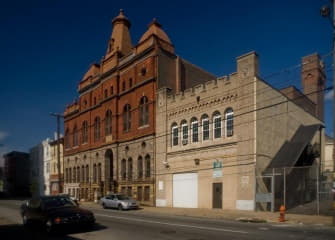
Columbia Singing Society, 2007-13 North 2nd Street, West Kensington
Nominated by the Philadelphia Historical Commission, this Second Empire-style hall was constructed in 1889 for the Kensington community of German immigrants. Although Philadelphia Quakers discouraged public musical gatherings, German immigration brought many professional musicians to the City. The three-story, five-bay brick hall has a raised golden sandstone basement and marble-clad first floor. The grandeur of the hall, fitted with a stage and ten pin alley, is a testament to the stature of the Society.
Garsed-Bromley Mansion/Frankford Y, 4704 Leiper St, Frankford
Nominated by Joseph Menkevich, representatives of the Frankford Historical Society, former Frankford Historical Society president Debbie Klak and Diane Sadler, this is a stately 1860s brownstone mansion that mixes Italianate with the French Second Empire style, not unlike the Union League. A front porch runs the width of the façade, with capitals that blend Corinthian, Ionic and Doric details. The home was built for the Garsed family who established profitable cotton mills in Frankford, and who were implicated in the “great cotton swindle” of the Civil War. The home and an addition served as the Northwood Frankford Community Y from the 1940s until 2009.
Sloan House, 1527 North Front Street, Fishtown
Nominated by Kensington Olde Richmond Heritage, LLC, and historian Oscar Beisert, the Sloan House was constructed between 1852 and 1854. It is a three-story, five-room brick building influenced by Georgian and Greek Revival styles, with marble steps, sills and lintels. It anchors one side of an institutional courtyard formed by the adjacent church, a distinctive element of urban design in 18th and 19th century Philadelphia.
339 E Wister St, Germantown
Nominated by historian Oscar Beisert and archivist J.M. Duffin, the original structure on this property is one of the oldest single-family homes in Germantown, dating to 1797. Known as Woodside, it was the country house of the wealthy Dorfeuille-Hackers, and remained in the family until 1904. With additions that quadrupled the size of the house, it eventually became Wister Gardens, a multi-unit apartment. The structure maintains a symmetrical façade and hints of Philadelphia’s Georgian architectural antecedents, despite being constructed in a manner characteristic of building types in 18th century Germantown.
Robinson Store, 1020-24 Market St, Washington Square West
Nominated by Benjamin Leech for the Preservation Alliance for Greater Philadelphia, this mid-century modern commercial building sits across from the former Gallery. An angled wave of tile is the distinguishing feature of the storefront designed by Victor Gruen, the “father of the shopping mall” and his wife Elsie Krummeck.

Ott Camera, 6901 Castor Ave, Oxford Circle, North Philadelphia
Nominated by Benjamin Leech for the Preservation Alliance for Greater Philadelphia, this 1955 shop has been called “one of America’s finest examples of modernism on Main Street.” Designed by Allan A. Berkowitz, the shopfront is clad in opaque buff-colored structural glass panels framed by a ribbon of dark red glass trim. Above second-floor casement windows a large sign spells “Ott” in green neon-lit metal channel letters. In form and materials the building is a significant illustration of European design trends that fully blossomed in post-war American commercial architecture.
Dougherty Bonded Warehouse, 1132-40 N Front St
Nominated by Kensington Olde Richmond Hertiage, LLC, and historian Oscar Beisert, the four-story distillery of J.A. Dougherty’s Sons was constructed in 1864 and enlarged in 1880. It represents a pure example of the Italianate style applied to industrial buildings of the era, with its red brick fascia, marble sills and steps, arched windows with brick corbeling. Dougherty’s immensely successful Pure Rye Whiskey was produced on this site until the firm was shut down by Prohibition in 1919.
4050-52 & 4054 Chestnut St, University City
Nominated by professor Aaron Wunsch, University City Historical Society president Elizabeth Stegner, and historian Oscar Beisert, these three houses, two of which are attached, feature Italianate bracket-and-dentil cornices, segmental-pediment dormers and paired, round-headed sash. These twins were commissioned by Thomas H. Powers, the eminent chemical magnate and real estate developer, as part of a larger development intended to lure city-dwellers west in anticipation of the 1876 Centennial Exhibition. These are among the eight surviving homes on the block that are listed in the National Register of Historic Places.
1026-28 Belmont Ave, West Philadelphia
Nominated by the University City Historical Society, with preservationist Andrew Cushing and historian Oscar Beisert, this Italian Renaissance Revival fire house was built in 1896 for Engine Company No. 16. It is among the few surviving smaller municipal buildings designed early in his career by John T. Windrim, the architect of the Wanamaker Building, Franklin Institute and Family Court Building. No. 16 is a three-story brick and terra cotta building, with a sculpted seal of the City of Philadelphia, garland keystone on the garage arch and white sandstone ground floor façade.
At its June meeting, the Historical Commission’s Committee on Historic Designation had received a near-record 20 nominations for properties to be added to the Historic Register, recommending that nearly all be forwarded to the full Commission. The Commission ultimately denied one nomination, tabled others that were incomplete, and admitted the above properties to the Register, some unanimously.
“The addition of these properties to the Philadelphia Register of Historic Places ensures that any significant alterations proposed for these buildings first gain approval of the Philadelphia Historical Commission,” said Patrick Grossi, advocacy director of the Preservation Alliance, “and likewise that every effort be made to maintain and rehabilitate these properties so that they live on fully into the next century. Moreover, they establish an anchor for the neighborhoods in which they are located, a sense of place in an era where character and form are routinely under threat.”
The Preservation Alliance for Greater Philadelphia actively promotes the appreciation, protection, and revitalization of the Philadelphia region’s historic buildings, communities, and landscapes. A 501c3 non-profit membership organization, the Alliance leads in setting the agenda for preservation issues of regional importance and advocates strong public preservation policies. Visitwww.preservationalliance.com.

