
Summary
- Investor expectations of the strength of GE Aviation, which is the source of 60% of operating income, are inflated.
- Investors were very favorably impressed by GE’s announcement of $55 billion of orders for jet engines at the Paris airshow. In reality, GE will receive about $18 billion.
- GE's stock is very volatile, so a disappointment could result in a sharp drop in price.
- GE Stock price
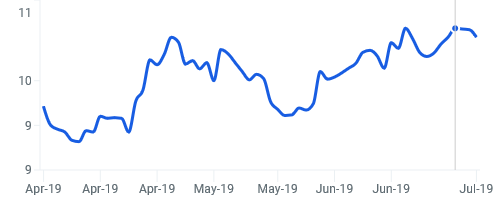
GE (GE) stock reacted very well to the announcement of $55 billion of orders from the Paris Airshow. This is good news but it is not as good as the market thinks. The $55 billion of orders will produce only $18 billion of orders from 2020 to 2025. GE is overvalued and it is a sell.
Wall Street Reaction
Following GE Aviation’s $55 billion in sales, Zacks Equity Research named General Electric as the Bull of the Day, on June 28. It said, “Their aviation group, which focuses on manufacturing plane engines, has been this firm’s “knight in shining armor”, growing GE’s top and bottom line for years and now makes up 60% of the firm’s operational profits.”
The Paris Orders
The LEAP-1A engine accounted for 90% of the orders as shown below. The LEAP is built by CFM, a 50 -50 joint venture with Safran (OTCPK: SAFR.F). LEAP competes with the Geared Turbofan Engine (GTF) made by Pratt and Whitney division of United Technology (UTX). GE won 74% market share in the market for Airbus A320neo and A321neo engines.
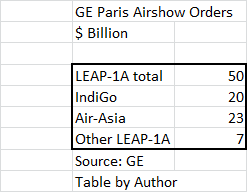
GE won a $23 billion IndiGo order for LEAP engines and service for 280 aircraft. IndiGo had used the Pratt and Whitney GTF engines on its first A320neos. This led to the following comments at the show:
“GE was willing to be more aggressive than we were in cutting its price to win the order.”
Pratt President Bob Leduc

“Those of you that have read the press over the last two years know the trials and tribulations that IndiGo has had. They’ve had their fair share of problems.”

GE Aviation president and GE vice chairman David Joyce
So who is telling the truth? They both are. The Pratt and Whitney GTF engine had more reliability problems than the CFM LEAP. As a result, the airlines backed away from the GTF and went with the LEAP engine even though the Pratt and Whitney engine was slightly more fuel-efficient. IndiGo experienced costly problems with the GTF engine. Now, most of those problems have been fixed. The reputation is gradually improving. For Pratt & Whitney a 26% market share is an improvement, particularly since most of GE orders came from the two-mega orders that will be difficult to repeat. GE wanted a win, and they were willing to shave price to get it. Most of the price shaving appears to come on the service contract.

