
Summary
- For years, General Electric has been a disappointment for shareholders as the company has spiraled lower.
- Now, the picture appears to be turning some, with its hard-hit Power segment showing some signs of stabilization.
- The segment is still likely to cause pain for the foreseeable future, but it looks like the bottom is in or is not too far off.
- Looking for a helping hand in the market? Members of Crude Value Insights get exclusive ideas and guidance to navigate any climate. Get started today »
The past couple of years have not been particularly nice for General Electric (GE) and its shareholders. The massive industrial conglomerate has been slammed by weakness in some of its key markets, plus it has been hurt by a high amount of debt, compressed margins, and fears from investors over things like potential fraud, and the company divesting its way into irrelevance. Undoubtedly, the hardest hit of its major business lines has been its Power segment, which sells gas turbines and other related equipment and services. Though it's very likely that this segment will continue to suffer for the next year or two, possibly more, the worst does appear over and the business is beginning to see some positive developments that could lead to increased shareholder value in the long run.
Financial results are encouraging
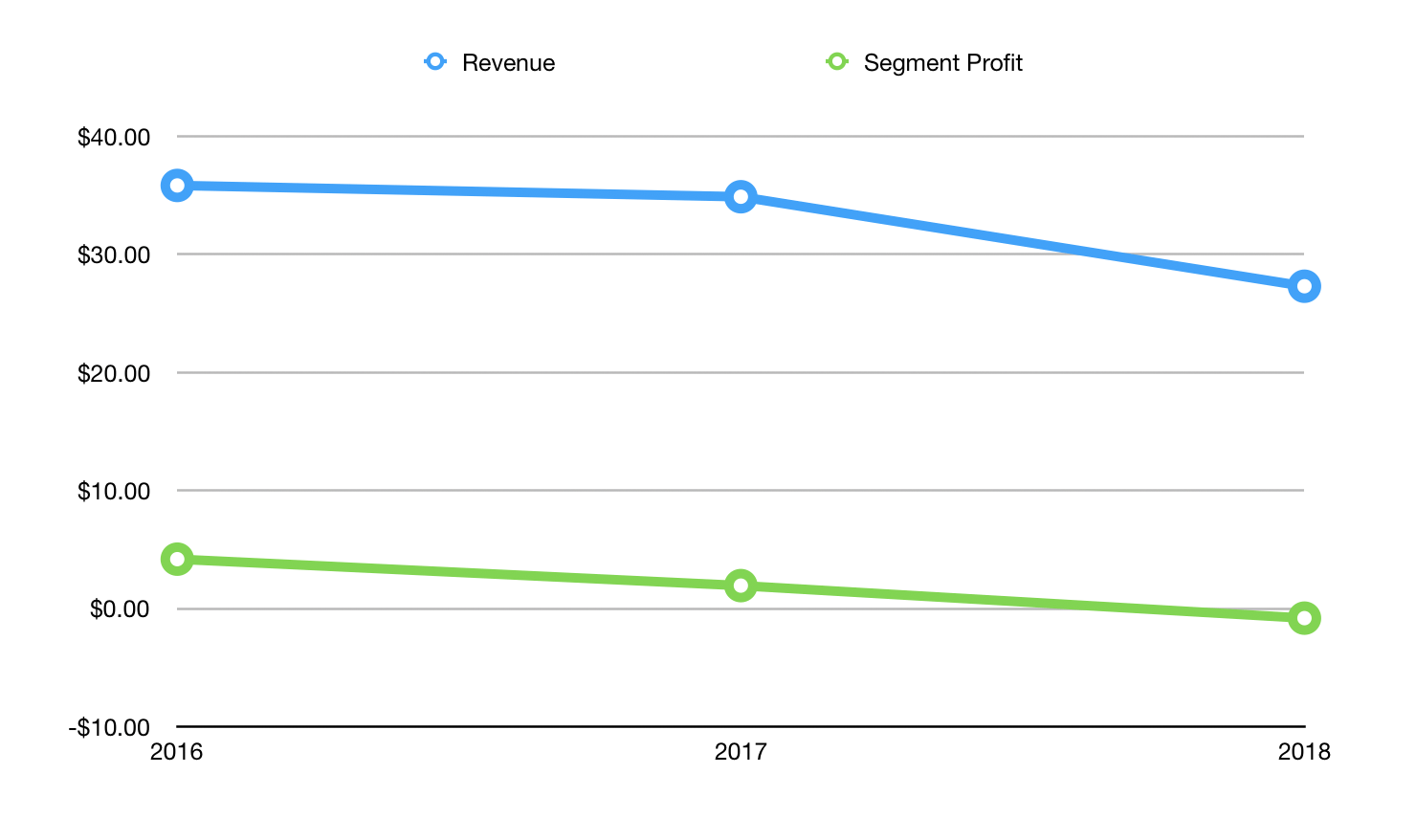
To get a look at how Power is faring, perhaps we should look first and how far it has fallen from grace in just the past few years. In the graph below, you can see both revenue and segment profits for the segment in question. Between 2016 and 2018, driven in part by corporate realignments but mostly by the impact of the industry in which Power operates weakening, revenue dropped 23.8% from $35.84 billion to $27.30 billion. Over that same period of time, segment profits declined too. They dropped from a profit of $4.19 billion in 2016 to a loss of $808 million last year. This turn negative makes sense when you consider that the segment in question operates in a space dominated by high fixed costs. Though not shown in the graph, backlog for the segment did decline some. From 2016 to 2017, it grew from $95.6 billion to $98.1 billion, while from 2017 to 2018 it fell to $91.9 billion.
Created by Author
This year has not been much better. In the first three quarters of 2019, revenue fell from $16.77 billion to $13.22 billion. Profits over that same period of time, though, actually improved, rising from a loss of $22 million to a gain of $84 million. In the last fiscal quarter, we saw a similar trend with both revenue and earnings. Revenue ended up declining from $4.56 billion in the third quarter last year to $3.93 billion in this latest quarter. Profits, meanwhile, improved from a loss of $676 million in the third quarter of 2018 to $144 million now. Over this same period of time, as orders fell from $16.3 billion to $12.4 billion year-to-date, and from $5.5 billion to $3.9 billion in the latest quarter, backlog dipped only slightly from $86.9 billion to $86.8 billion.

Created by Author
Context is needed
When looking at the latest financial results, it may seem like there isn't much hope for shareholders to grasp onto. Fortunately, though, context can clear some of the recent pain up. Last year, for instance, management made some changes to what constitutes its Power segment. This includes the realignment of its Grid & Lighting operations, among other changes. Due to these corporate changes, the actual organic picture for Power no longer looks quite as bad as it otherwise would have. Take, as an example, the company's last quarterly results.
During the third quarter of its 2019 fiscal year, organic revenue for Power actually only declined by $0.1 billion compared to the same time last year. At the same time, profits there grew $0.6 billion. These changes, according to management, were largely attributable to improved variable costs surrounding productivity within the segment. Ultimately, the improved bottom line is more important than the drop from the bottom line, but these results are still better than the $532 million improvement in the bottom line and the $633 million drop in the top line seen if we ignore organic vs. non-organic changes. It's worth mentioning that the same kind of improvement can be seen when looking at the picture year-to-date. Revenue from this perspective dropped $0.5 billion (compared to total organic plus non-organic revenue declining $3.54 billion), while profits are up $0.3 billion (compared to the $106 million for profit as a whole).
This isn't to say that everything is perfect with Power. Year-to-date, organic orders at Power are down $0.4 billion year-over-year. For the latest quarter as a whole, the picture is even worse. Orders here have declined by $1 billion compared to what they were the same time last year. This suggests that some issues still exist in the industry, but as even with this, investors should not despair. As I pointed out in one of my more recent articles on General Electric, Power's free cash flow for this year should now be about flat compared to the $2.7 billion ($2.3 billion adjusting for the changes made to the segment) that the firm lost in its 2018 fiscal year. This is an improvement over management's expectation in March of this year that Power would see its cash flow situation actually worsen.

