
Summary
- Sue Nabi, Coty's new CEO, is regarded as one of the best managers in the cosmetics industry and is likely to be the game changer for the company.
- Luxury brand licenses are a huge asset in a world with a rapidly growing Asian middle class and will propel Coty’s growth.
- Despite various uncertainties, Coty is a low-risk investment as it is heavily backed by both JAB Holding and KKR.
- Coty’s share price is likely to double within three years, even with very modest assumptions.
Editor's note: Seeking Alpha is proud to welcome Outperforming Stocks as a new contributor. It's easy to become a Seeking Alpha contributor and earn money for your best investment ideas. Active contributors also get free access to SA Premium. Click here to find out more »
Coty, Inc. (NYSE:COTY) was one of the worst-performing stocks for many years. However, various changes within the company and the low valuation provide the stock with a compelling risk/reward ratio that you probably do not want to miss out on.
What Happened So Far
For many years, JAB Holding had the plan to transform the fragrance company Coty into a global cosmetics powerhouse. After the aspired takeover of Avon failed in 2012, Coty acquired more than 40 beauty brands from The Procter & Gamble Company (NYSE:PG) in 2016. However, the paved way turned out to be very bumpy soon. Coty's familiar culture clashed with the rather not so familiar one of the newly added brands. Subsequently, shareholders went through tough times, seeing their holding plunge from $32.68 to $2.65.
Nevertheless, JAB Holding was still convinced by its investment and boosted its stake in the company from 40% to 60%. In order to propel its turnaround, Coty announced a strategic partnership with KKR regarding its professional beauty and retail hair businesses (so-called Wella business) in May 2020. The business will be carved out into a standalone company in which KKR will acquire a 60% stake and Coty will retain the remaining 40% interest. The deal is on track to close by end of CY20. It will result in total net cash proceeds to Coty of around $2.5 billion. Moreover, KKR made a $1 billion investment into the company via convertible preferred shares (coupon of 9%; convertible into Coty shares at $6.24). Assuming full conversion, KKR will be Coty's second largest shareholder with a 17% stake. JAB will remain the largest shareholder with 50% ownership in the company. In addition to that, Coty presented its "All-In To Win" transformation agenda on June 1. The key pillars are revenue generation, cost reduction and the return to an entrepreneurial spirit.
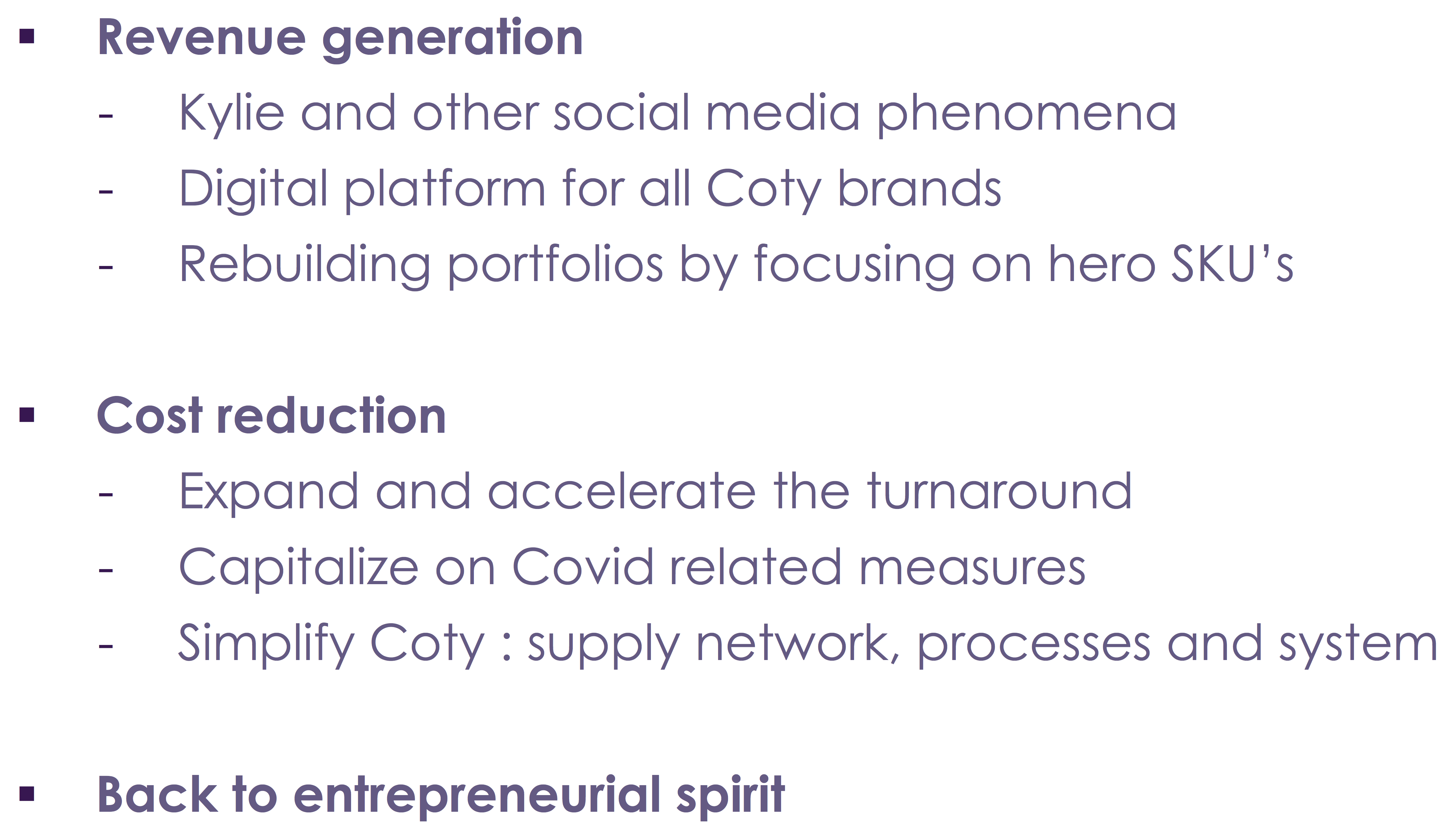
'All-In To Win' Transformation Agenda, Source: Coty Update, June 1, 2020
In the following, I will conduct an industry and SWOT analysis in order to show in which areas Coty can build on its strong foundation and where it has work to do. In addition to that, a fundamental analysis will be conducted.

