
Summary
- Most of Macy's unsecured debt issues trade at significant discounts to par, including several 2023 and 2024 maturities.
- After raising $4.5 billion of new financing earlier this year and stabilizing its cash flow, Macy's now has a substantial amount of excess liquidity.
- Debt repurchases at a discount would increase the intrinsic value of Macy's stock while reducing interest expense and (in the long run) improving the balance sheet.
- With 10%-12% yields-to-maturity, Macy's 2023 and 2024 debt maturities offer a favorable risk-reward tradeoff. Macy's stock has even greater upside, but with more risk.
Just a few months ago, Macy's (M) closed a massive new financing package to help it survive the COVID-19 pandemic. The approximately $4.5 billion deal consisted of $1.3 billion of senior secured notes backed by some of the company's real estate assets and a $3.15 billion credit facility secured by inventory.
At the time Macy's lined up the financing, it was bracing for a roughly $1 billion Q1 operating loss and outgoing CFO Paula Price was warning that gross margin could be even worse in the second quarter of 2020 than it was in Q1.
However, Macy's has been able to stem the pandemic-related bleeding faster than expected. This has left it with excess liquidity. With much of Macy's unsecured debt trading at a discount to par (including some near-term maturities), management may consider deploying some of this liquidity to buy back debt at a discount to get a head start on the debt reduction that clearly will be necessary post-pandemic. Buying back debt at a discount could be a value catalyst for shareholders as well as other holders of Macy's debt.
Signs of stabilization
Macy's Q1 results ultimately came in near the favorable end of the preliminary estimates management provided. Net sales fell 45% year over year. Excluding real estate gains and special items, the company posted a $951 million operating loss.
Fortunately, demand recovered more than expected over the summer. Sales fell 35% in the second quarter. Gross margin rose 650 basis points sequentially to 23.6%. Finally, Macy's implemented aggressive cost cuts, reducing SG&A spending by 36%. The net result was that Macy's slashed its operating loss to $389 million in Q2.
There are promising signs that Macy's results will improve further in the second half of fiscal 2020. The company's guidance calls for sales declines to moderate further to roughly 20% to 25%. Additionally, Macy's exited the second quarter with lean inventory, so it expects gross margin to be down mid-single digits year over year in Q3 and Q4, compared to down 18 percentage points year over year in the first half of the fiscal year.
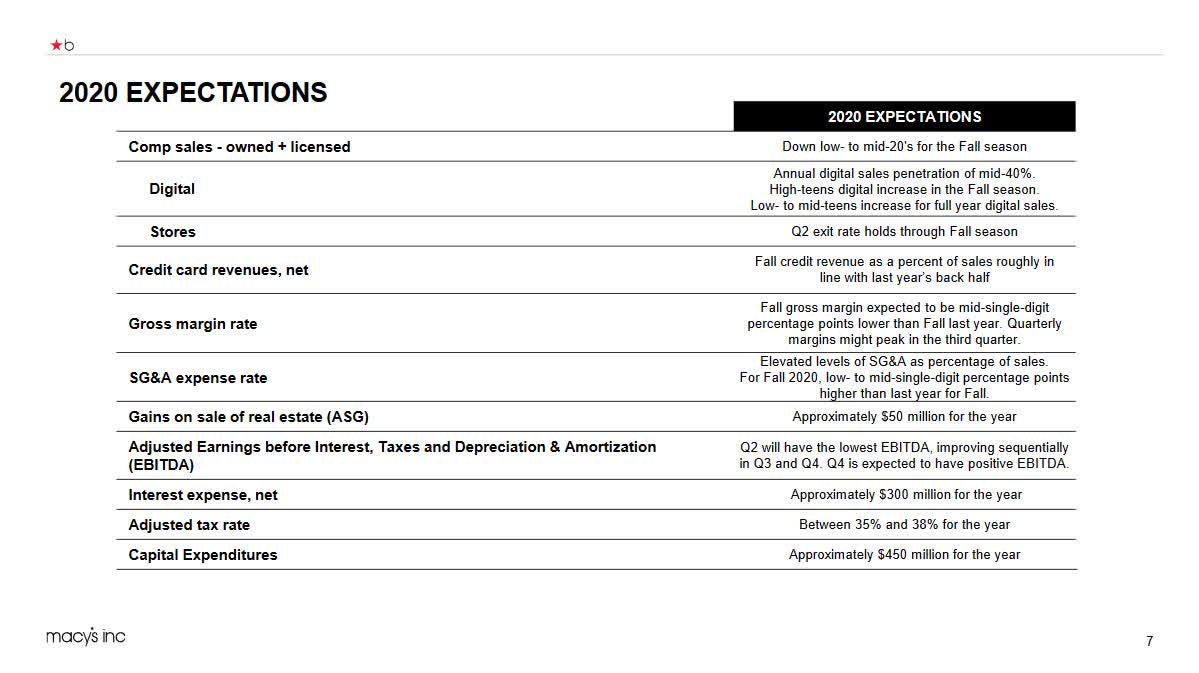 (Source: Macy's Q2 2020 Earnings Presentation, slide 7)
Macy's won't report its Q3 results until Nov. 19, but the latest retail sales report provided another bullish data point. Seasonally-adjusted department store sales declined 2.2% sequentially from July to August but then rose 9.7% sequentially in September. While sales are still down year over year, the pace of declines has continued to moderate, potentially even faster than Macy's management was counting on.
In short, the bulk of the evidence points to sequentially improving performance at Macy's, taking many of the worst-case scenarios off the table. One caveat remains, though: COVID-19 cases are increasing rapidly in many parts of the U.S., which could potentially lead to new restrictions and behavioral changes that hurt Macy's.

